 Lysá nad Labem
Home page • Baroque Lysa • Town hall • Information service • Business |
|
|
|
|
Home page • Baroque Lysa • Town hall • Information service • Business
The date of the last actualization: 7.7.1999
Lysa nad Labem - the town of Frantisek Spork. The gloomy, dreamy beauty of the Baroque monuments quietly consorts with the bustle and modern trade fair industry of the town. The vision of Frantisek Antonin Spork has been fulfilled: ".......my town will outlive me and one day what I leave behind will remind you of my fight for truth and justice....". The words of the great 18th century patron of art have turned out to be right and we are living out his legacy now with all respect and dedication. Welcome and allow us to briefly mention at least some of the priceless jewels of the town's Baroque wealth.
|
||
|
|
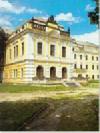
Chateau The chateau owes its present appearance to Baroque and Classicist reconstruction in the late 17th century and throughout the 18th century. A chateau park, enhanced by unique sculptures, was created during the adaptations. The chateau is formed by the main front building and two wings. A chateau chapel of the Magi was build around 1729 in the corners of the Rudolph's (east) wing and the main building, on the original site of a castle tower. A passage way, connecting the honorary yard and the park, runs through the Rudolph's wing. A raised, sandstone alliance coat-of-arms of the Sweerts-Spork families with a big count's crown, richly decorated with acanthus leaf ornaments, is situated on top of the park gate cornice. The chateau interiors are not open to the public, the premises serve the needs of an old people's home. The interior ceilings are decorated with frescos with mythological and biblical motifs, the walls by vedutas and, on the second floor, by a war motif of the famous battle of St. Gotthard given by General Jan Spork. The chateau chapel serves its original purpose. It is consecrated to the Magi, depicted in the main altar painting by P. Brandl.
|
|
|
|
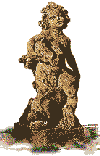
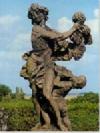
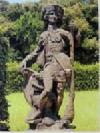
Chateau Park In the course of two centuries the park underwent complicated development. All greenery around the chateau was destroyed during the thirty-year war. It was only F.A. Spork in 1696 who laid the foundations of a decorative chateau garden. Later, after 1734, inspired by the visit of Count von Globen to Valec, he begins to build his own "fancy garden" in Lysa. He decorated it with the sculptures of allegories of the twelve months, continents, elements, seasons of the year, lions, sphinxes and others to create elegantly designed spaces and recesses of a French park. The park was extended to the current size of 21 hectares by Spork's son-in-law, Frantisek Karel Sweerts-Sporck, in 1744. The final park design dates from the period after 1851 when the Lysa demesne passed to the possession of Princess Stepanka of Rohan. The park's sculpting decorations form a unique collection, only comparable with the Kuks chateau allegories, although they differ in focus and execution. While the Kuks sculptures depict man, his character, virtues and vices, the Lysa complex is focused on nature and captures in stone the cycle of life and man's surrounding environment. This concept of a cycle of the twelve months, seasons of the year, day and night, natural elements and continents is unparalleled in the international art of sculpture (Versailles is only decorated by allegories of the twelve months). The sculptures of the months are set in two rows opposite each other in the hornbeam alley on the main axis, on pedestals whose four mirrors carry no longer intelligible German texts. They are considered to be the work of Frantisek Adamek Sr. of Benatky. Works provably created by the artist for the Lysa park include allegories of elements and the seasons of the year, situated between the first and the second parterre of the park. For their fragility and balance of composition the allegories of the four seasons form the pinnacle of the entire collection. They are fitted on the border of the first parterre, in the following order (from right): Summer, Spring, Autumn and Winter. More allegories, in the form of little putti, are fitted on the railing of the three sets of steps, descending from the first to the second parterre. The middle steps whose top part is decorated by the sculptures of Venus on the right and Adonis on the left are the only exception. In terms of style, these works significantly differ from those by Adamek. Below Adonis, in the lower part of the steps, there is an allegory of the Day (putti with the sun in an oval escutcheon). Opposite, there is an allegory of the Night with the motif of the moon and a star. The puttis are the work by Frantisek Adamek.
|
|
|
|
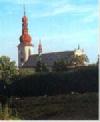
Church of John the Baptist With the tower height of 55 m, it is a prominent landmark of Lysa which welcomes the visitors coming from all directions, be it by road or railway. The church itself had a turbulent history since the beginning of the construction on 9 May 1719. The architectural design was made by Frantiek Maxmilian Kanka. The fence wall of the Church of John the Baptist carries the sculptures of all saints, the most precious one which is undoubtedly that of St. Jeronym. Braun depicts him as a person who strives to get emotionally detached from everything human. A straddling, half-dressed, stringy old man holding a scull in his raised arms (sometimes depicted with a stone in his hand) and looking into the skies, personifies a visionary type. The cloak which has slipped from his shoulders enfolds his hips in a bulging spiral and falls down his right leg in curly folds. Literally, it is a petrified moment of intensive religious ecstasy. In soft sandstone Braun unfolded his vision without reducing his individual, mature art speech.
|
|
|
|
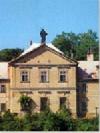
Monastery South of the chateau, where the top of the hill slopes steeply down to the Labe basin a complex of monastery buildings was built on the site of an old Gothic building in 1753 for Augustinian monks. The construction was commenced by Bartolomeo Scotti and completed by Alselmo Lurago. The ground plan of the monastery is a square, enclosing a rectangular courtyard. It was abolished by the Letter of Tolerance. The main building which faces the town is the most splendid part of the monastery. It has a shallow central 3-axial bay and two side wings, one being a mirror reflection of the other. The top of the gable is decorated by a sculpture of St. John of Nepomuk. In the direction of the church the southern frontage of the main building is also formed by a central 3-axial bay and two 4-axial side wings. The top of the gable is decorated by a sculpture of St. Nicolas.
|
|
|
|
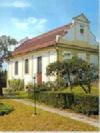
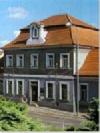
Evangelical Church The Evangelical Church in Lysa, dating from 1787, fully conformed to the spirit of the Letter of Tolerance, issued in 1781. Apart from religious freedom, it allowed non-Catholics to build houses of prayer - tolerance churches. However, the buildings had many limitations: apart from others, they were not allowed to have a tower, they had to resemble residential houses as much as possible and they were not allowed to be erected in public places. The church has a rectangular ground plan, its gables are terminated with triangular vaulted ends. A hall with the main entrance is built in the western frontage. The church interiors are modest, devoid of any decorations. Instead of altar there is a wooden carved pulpit on the eastern wall. A sarcophagus refectory, decorated with carved-out ornaments, is situated below it. It is said to have been donated by an Evangelic nobleman. The church is very well maintained and is one of the oldest monuments of this kind in Bohemia.
|
|
|
|
Municipal Museum Building The Museum forms the south-western terminal point of the Square of Bedrich Hrozny. It was built in 1754 as a hospital for the elderly by a native from Lysa, mason master Hebek. The main building with a rectangular ground plan has two side wings to which its lateral wings and the rear section are attached in the right angle. Together they form a square yard. The west lateral wing houses the museum of orientalist Professor Bedrich Hrozny - a native from Lysa. The museum building is one of the valuable monuments in town. Apart from the church it is the only document of the symmetry of Baroque architecture. The original purpose of the building was to serve people as a hospital. Today it serves the public again, as a link between the past and the present, both through the actual museum activities and through the exposition of oriental cultures and works by Bedrich Hrozny.
|
|
|
|
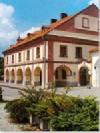
Town Hall On September 23, 1741, the owner of the demesne donated its land to the municipality of Lysa for free use. The authorities decided to build a new town hall. The construction was completed in 1747. The building has a rectangular ground plan, one floor, an austere, smooth facade and an arcade vaulted on six pillars, with cross-arched, three-severy vaulting without ribs. The two remaining severies have triangular sectors. The main entrance is situated in the middle of the southern frontage, in the arcade. A Baroque gate was added in the east, serving as a gateway into the yard. The top of the gate used to be decorated with a Baroque sculpture of St. Florian, currently on display on the fire station premises. An interesting feature of the town hall is its asymmetric arrangement of windows. It is the result of division of the interior space into rooms with the most diverse functions. The northern side of the building was extended in the middle by a new building of the municipal bureau.
|
|
|
The Baroque complex in Lysa nad Labem is a unique cultural and historic sight, admired both by its inhabitants and visitors. It provides countless opportunities for original artistic experiences and to learn from the knowledge and skills of our ancestors, to achieve the peace of mind and draw inspiration for your own creative activities. Everyone who has ever visited the sights is always delighted to go back. Text: Marie Kořínková Home page • Baroque Lysa • Town hall • Information service • Business Downloaded from: http://www.pvtnet.cz/www/mulysa/index.htm
|
||

 ysa nad Labem, a town with the population of 8 500, is situated in the fertile lowlands by the Labe river. The first historic mention dates back to the 11th century in connection with Prince Jaromir whose brother Oldrich imprisoned and blinded him, and later ordered his murder at the Lysa Castle. The municipal existence of Lysa nad Labem is first documented in 1291, when Queen Guta, the wife of Wenceslas II, issued a document unifying the settlements of Lysa in one economic unit. In the course of history the Lysa demesne was possessed by various owners: Premyslide princes, Czech queens, various noble families.

